




IZKI: Long before modern civil engineering formalised the mechanics of fluid dynamics, ancient Omani builders devised an ingenious solution to a recurring challenge: carrying precious water across roaring, flash-flood-prone Wadi beds without modern power, pumps, or concrete.
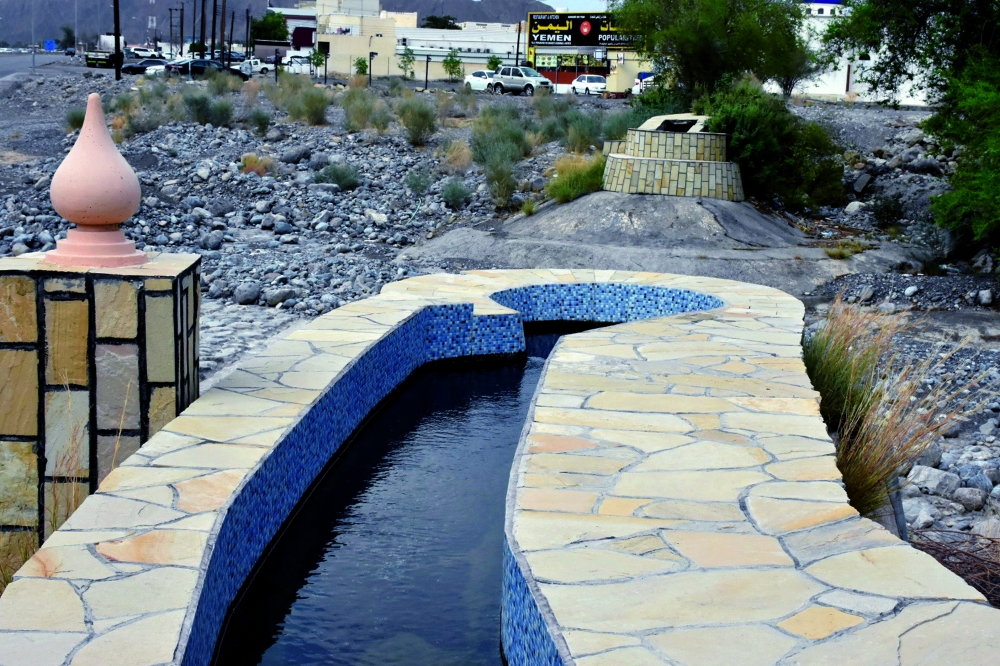
Known locally as the Gharraq Fallah (dunker-emerger) system—and in modern textbooks as an inverted siphon—this subterranean mechanism allows gravity-fed irrigation channels, or aflaj, to cross vast depressions. By steering water deep underground beneath seasonal torrents, ancient builders ensured uninterrupted flow to desert communities while keeping infrastructure safe from flood damage and evaporation.
One of the most striking examples of this technology survives in the Al Qaswat Falaj in the Wilayat of Izki.
According to Dr Said bin Shannan al Khalasi, Assistant Professor at the Unesco Chair for Aflaj Studies at the University of Nizwa, Al Qaswat is a deep, continuously flowing Dawoodi falaj. Extending nearly 6.4 kilometres from its mountain groundwater source, it produces up to 139 litres per second. Its history spans over a millennium, with references found in 11th-century classical manuscripts and a rare 17th-century document signed by Imam Nasir bin Murshid al Yaarubi.
The true engineering feat, however, lies in how the falaj negotiates its greatest natural obstacle: Wadi Halfayn, one of Oman’s largest and most powerful flood channels.
Traditional Omani irrigation relies on a continuous downhill slope. When Al Qaswat’s builders reached the steep, sprawling trench of Wadi Halfayn, bridging it above ground was impossible—floods would regularly sweep away aqueducts. Instead, they built the Gharraq Fallah.
Using local stone bonded with Sarooj—a traditional, highly durable Omani hydraulic mortar made of specially fired clay—builders constructed a sealed conduit running directly beneath the riverbed.
The system relies on the communicating vessels principle: The Gharraq (Dunker): Water enters a vertical intake shaft on one bank. Subterranean Transit: Driven by hydrostatic pressure, the water surges down and through a sealed subterranean tunnel beneath the wadi bed.
The Fallah (Emerger): Because the source origin sits at a higher elevation than the exit, pressure forces the water upward through an outlet shaft on the opposite bank, resuming its open-air flow.
Centuries before French physicist Blaise Pascal mathematically defined hydrostatic pressure in the 17th century, Omani builders were deploying it in the desert. Master craftsmen, known as Areefs, calculated precise gradients without modern surveying tools—using trial channels, taut visual sighting lines, and vertical inspection shafts spaced every 15 to 18 metres along the route.
"While other ancient civilisations, like the Romans, built massive elevated stone aqueducts, Omani engineers chose the opposite path by hiding the channel underground," notes Dr Al Khalasi. "It required a sophisticated grasp of water behaviour."
Interestingly, nature offered its own template. Nearby at Al Hoota Cave, rainwater enters an upper cavern at 1,000 metres elevation (a natural Gharraq) and travels 3 kilometres underground before emerging at 700 metres (a natural Fallah), suggesting early builders learned directly from observing local geology.
Today, Al Qaswat's ancient siphon remains fully operational. Utilising a traditional time-sharing system based on the Athar (a 30-minute unit), it reliably divides water between the villages of Saddi and Harat al Raha, sustaining over 4,000 residents through pure physics and centuries-old Omani ingenuity.
Oman Observer is now on the WhatsApp channel. Click here